19 April, 2011

The Whale Road, by Robert Low. Book review

Harper Collins, 2007. ISBN 978-0-00-721530-0. 334 pages

The Whale Road follows the adventures of a band of Norse mercenaries in 964/965 AD in Scandinavia, Russia and the Ukraine, set against the backdrop of the emerging Rus kingdoms around Kiev. The historical figures Sviatoslav of the Rus and his sons Yaropolk and Vladimir have walk-on parts. Harald Bluetooth of Norway and Denmark is an important off-stage presence, and Attila the Hun – a historical figure from 500 years earlier – is the subject of the heroes’ quest. The legendary Volsungs also feature. All the main characters are fictional.

Brought up on his uncle’s farm in Norway, Orm Ruriksson knows his father only as a name, until a threat from the uncle brings Orm’s father home to take vengeance and to sweep Orm away to a new life as a warrior of the Oathsworn. Sworn to each other and to their formidable leader Einar the Black, the Oathsworn are a verjazi band, Norse mercenaries who travel and fight for pay. This time they are on a quest for a rune-inscribed sword and the legendary hoard of Attila the Hun, trying to keep one step ahead of rivals and ex-employers who are also seeking the same treasures. The trail will lead them across the wild oceans and deep into the Russian steppes to face battle and treachery and dark magic – and the inexorable doom woven by a broken oath.

As the author says in his ‘Note on the history’, this is “...a saga, to be read around the fire against the lurking dark.” It has classic saga ingredients – a sword engraved with runes that has magical symbolism in two religions, a beautiful woman with a mysterious link to the Otherworld, a mountain forge of immense antiquity, a long-lost treasure hoard, desperate battles in far-off lands and epic sea voyages through storm and tempest. It also has something of the feel of the Icelandic sagas beyond the adventure, partly from the prose style and partly because of the sense of grim and implacable fate closing in as a result of the characters’ own choices and the unyielding demands of oath and obligation. The language is laconic, sprinkled with occasional vivid phrases reminiscent of Norse kennings, e.g. “...[the ship] leaped like a goosed goodwife”, “windows comfort-yellow with light”, “crow-wing hair”. The title of the novel itself is a classic Norse kenning – the whale road is the open ocean. Dialogue is terse and lively, liberally laced with black humour and Scots or Norse dialect terms. In keeping with the hard-drinking, hard-fighting life of the main characters, modern four-letter words are frequent; readers who are offended by words such as f**k and c**t may like to consider themselves warned.

The book is narrated throughout in first person by Orm. I often dislike first-person narratives, as the reader sees only the narrator’s point of view, but fortunately Orm is intelligent and interested in working out hidden information and in trying to understand other people’s motivations.

The plot is non-stop action, with plenty of casual violence (the “Glasgow kiss” makes an appearance under another name), gory battle scenes and gruesome ways to die. As one might expect from the subject matter, it’s a dangerous novel to be a character in. The Whale Road captures the precarious nature of life as a mercenary warrior, forever poised between the possibility of riches beyond the dreams of avarice and the (much more likely) possibility of an unpleasant death. It is a little surprising that Orm, an inexperienced youth of 15, fits into this tough, ruthless band with apparent ease, although this might be explained by Orm’s ability to read Latin (which turns out to be a skill of considerable use to the fearsome Einar) and his father’s status as a respected member of the group.

A strong sense of the supernatural is woven through the narrative. Storms are sent by angry gods, a lost comrade has to be honoured by a sacrifice, and who else would emerge from an abandoned mine under a mountain but an angry black dwarf wielding a hammer (a scene that still makes me laugh weeks after reading it)? For the most part the supernatural exists in the minds of the characters; the exception seems to be the mysterious and beautiful Hild with her aura of evil spirits, dark magic and supernatural link to the mysterious treasure hoard.

A useful map at the front of the book and a list of place names with their modern equivalents at the back is helpful for following the Oathsworn on their epic journeys, and a ‘Note on the history’ gives a brief summary of the historical background to the tale. There is no glossary for the colourful Norse terms; I recognised most of them and those that were new to me were clear from the context, but I have a long-standing interest in Norse history. Readers who are not familiar with the period may find the Norse glossary on the author’s website useful.

Gripping saga of epic journeys by land and sea, hard-fought battles and the dark power of oaths, as a band of Norse mercenary warriors seek a legendary sword and a long-lost hoard of cursed silver in tenth-century Scandinavia and Russia.

16 April, 2011

April recipe: Hot cross buns


Hot cross buns!
Hot cross buns!
One a penny, two a penny, hot cross buns
If you have no daughters, give them to your sons
One a penny, two a penny, hot cross buns
--Traditional rhyme

Another version uses ‘one ha-penny, two ha-penny’, ha-penny meaning half a penny. The variant I know was evidently coined in more inflationary days :-) I have no idea of the significance of the line about daughters and sons, if indeed it has any beyond a convenient rhyme and scan. Feel free to speculate.

According to the Oxford English Dictionary, the earliest recorded use of the phrase ‘hot cross bun’ is in 1733:

Good Friday comes this Month, the old woman runs With one or two a Penny hot cross Bunns.
--Oxford English Dictionary

It seems likely to me that some form of enriched sweet bread baked to celebrate a spring festival goes back a lot further than 1733, though in the absence of evidence you can choose your own favourite theory about the origin of the recipe and the significance of the cross. Wikipedia has a few to choose from. It would be terribly prosaic to suggest that two intersecting cuts across the top of a loaf may have started out as a convenient way of dividing it into four pieces.

There are as many variants of hot cross buns as there are cooks. You can vary the dried fruit (some recipes even substitute chocolate chips), you can vary the spices, you can glaze the buns with honey or icing, and the cross can be marked with pastry, flour-and-water-paste, icing or simply slashed with a knife. Take your pick. Here’s my recipe, and a happy Easter to you when it comes.

Hot cross buns

Half a cup (about 2 fluid ounces, or abut 50 ml) tepid water
1 teaspoon (1 x 5 ml spoon) granulated sugar
2 teaspoons (2 x 5 ml spoons) dried yeast*
1 lb (approx 450 g) strong white flour
2 oz (approx 50 g) light brown soft sugar
2 oz (approx 50 g) butter
2 teaspoons (2 x 5 ml spoons) ground mixed spice
0.5 teaspoon (0.5 x 5 ml spoon) salt
2 oz (approx 50 g) sultanas
1 oz (approx 25 g) currants
1 oz (approx 25 g) cut mixed peel**
1 egg
Milk to mix

Dissolve the granulated sugar in the tepid water and sprinkle the yeast on top. Set aside in a warm place for about 20 minutes until frothy on top. (If using the kind of dried yeast that needs no activation, follow the instructions on the packet).

Mix the light brown soft sugar, flour, salt and spices in a bowl, and rub in the butter. Stir in the dried fruit and peel.

Pour in the yeast liquid, then the beaten egg. Mix well. Add milk until the mixture forms a soft dough. (If it is floury and flaky, add a little more milk. If it is sticky, you have added too much milk; add a bit more flour).

Turn the dough onto a floured work surface and knead for a few minutes until smooth.

Put the dough back in the bowl, cover with a damp cloth, and leave in a warm place to rise for about 1 hour. It should roughly double in size.

Knead again for a few minutes, then shape the dough into 12 buns. Place the buns on a greased baking sheet so they are just touching. Make two intersecting cuts with a knife on the top of each bun to form a cross.

Cover with a damp cloth and leave to rise in a warm place for about 1 hour.

Bake in a hot oven, about 220 C, for about 20-25 minutes until golden brown.

Cool on a wire rack. If liked, brush the tops of the warm buns with honey to make them sticky.

Serve warm or cold, with butter. Any left over will keep for a day or so in an airtight tin, or can be frozen.


*This is the kind of dried yeast you have to activate in warm water before using.
**Cut mixed peel is the UK name. I think it may be called ‘candied citrus peel’ or similar in the US..

08 April, 2011

Kathleen Herbert and Moon In Leo


Kathleen Herbert wrote three historical novels set in what is now northern England and southern Scotland during the Heroic Age of early medieval Britain (late sixth and early-to-mid seventh century), Bride of the Spear (first published as Lady of the Fountain), Queen of the Lightning and Ghost in the Sunlight. I read them a while ago and liked them very much indeed (all are now out of print, but second-hand copies are reasonably readily available).

Last year, I learned through Sarah Johnson's blog Reading the Past that Kathleen Herbert had written a fourth novel, Moon In Leo, before experiencing ill-health. Her friend Connie Jensen set up an independent publishing company, Trifolium Books, and in February this year Moon In Leo was published as their first title. I bought a copy straight away, and am delighted to find that it's well up to the high standard of the three previous novels (review to come in due course).

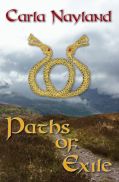
Moon In Leo is also set in northern England, in the romantic landscape of the Furness peninsula and Morecambe Bay in South Cumbria - the cover photograph (see above) captures the atmosphere well - but at a completely different time in history, Restoration England in 1678. Here's the back cover copy:

People turned out of their homes; others living rich beyond the dreams of the dispossessed. Science struggling with superstition; celebrity and royalty parading in a public sexual carnival. This love story takes place among the political intrigues and religious hatred of England's age of upheaval between civil war and 'glorious revolution'.

Of the two men in Rosamund Halistan's life, one is a fellow scholar of the occult, the other a wild hedonist with tragic memories. She suspects both of them on attempts on her brother's life and designs on her body and land.

It's harder to find a safe path through the thickets of treason and bigotry than through the rip-tides and quicksands, solid routes and sanctuary in the sands of Morecambe Bay.


More about Trifolium Books and Moon In Leo on the company's blog here.

Map link: Furness

31 March, 2011

The Daughter of Time, by Josephine Tey. Book review

First published 1951. Edition reviewed: Arrow, 2002, ISBN 0-09-943096-7. 220 pages.

The Daughter of Time is a historical mystery set in 1950s England. All the main characters are fictional but the mystery they are attempting to solve is a real one, the disappearance of the ‘Princes in the Tower’ during the reign of Richard III in 1483.

Inspector Grant of Scotland Yard is laid up in hospital with a broken leg. Bored by the predictable reading material proffered by well-meaning friends, he becomes interested in studying historical portraits. One in particular captures his imagination; he thinks the face should belong to a judge or a statesman, and is astonished to find that it is a portrait of Richard III, whom he vaguely remembers from history and Shakespeare as the archetypal wicked villain. Puzzled that the face in the portrait looks so different from his expectations, Grant enlists the aid of his friends and the hospital staff to investigate Richard’s career and the mystery surrounding the disappearance of his young nephews, the ‘Princes in the Tower’. Did Richard III really have them murdered as Grant’s history lessons said, or can the evidence bear some other interpretation – and point to some other culprit?


This is an unusual and ingenious historical mystery, and I found it a delight from beginning to end. It would earn a place in my heart just for Grant’s splendidly dyspeptic opinion of production-line romances, thrillers and gloomy literary fiction:

“The Sweat and the Furrow was Silas Weekley being earthy and spade-conscious all over seven hundred pages. […] The rain dripped from the thatch and the manure steamed in the midden. Silas never omitted the manure. It was not Silas’s fault that its steam provided the only up-rising element in the picture. If Silas could have discovered a brand of steam that steamed downwards, he would have used it.”
This passage appears on the second page and sold me straight away. The rest of the writing lives up to the initial promise, crisp, elegant and compact with not a word wasted. The contemporary characters are sketched in with a few bold brush-strokes that bring them vividly to life as individuals with their own quirks and foibles: the soppy nurse; the brisk nurse; flamboyant Marta, for whom the word ‘actressy’ could have been invented; the rather vague student who is suddenly galvanised when Grant’s investigation catches his interest.

Like The House on the Strand (reviewed earlier), although a very different novel, The Daughter of Time captures the thrill of pursuing an intellectual puzzle and the satisfaction that comes from tracking down an elusive fact. Grant becomes so absorbed in each new scrap of evidence that he quite forgets the discomforts of his injury and the frustrations of confinement. Don’t look for action – the entire novel takes place in Grant’s hospital room, with assorted friends bringing him books and snippets of information. This is a chase purely of the mind, but no less gripping for that. I would hazard a guess that anyone who has pursued a tricky question through obscure historical sources will recognise Grant’s quest.

The Daughter of Time uses Grant’s investigation of Richard III to explore the processes by which actual events get turned into simplified and widely accepted narratives of history, which then take on a life of their own and become highly resistant to question. Grant complains that people do not like having their preconceptions challenged, and then promptly proceeds to demonstrate it himself by taking comical personal offence at his discovery that Thomas More was not a contemporary biographer of Richard III as he had previously believed. For me, this is one of the key strengths of the novel. It reminds the reader, in dramatised form, that many of the things we think we know as ‘fact’ are probably nothing of the kind. Critical thinking and assessment of evidence are vital in history – as in many other fields of study – and while interpretation may be necessary to make sense of an incomplete set of evidence, one should always keep in mind the distinction and be prepared to consider alternative interpretations. The Daughter of Time can be read as an enjoyable case study of that principle.

Although Inspector Grant is convinced that he has solved the mystery and exonerated Richard III, I would suggest that readers who are interested in the history of Richard III’s reign exercise caution before swallowing the (fictional) Inspector’s conclusions whole. The reason that the mystery of the princes’ fate still qualifies as a Mystery is because the definitive answer is not known with certainty and the limited evidence can support more than one interpretation, all of which answer some questions and raise new ones. I agree with Grant that the case against Richard III is far from proven; I part company in that I don’t think Grant’s alternative solution is proven either.

Ingenious, stimulating historical mystery with a sharp point to make about the importance of critical thinking, told in lively and economical prose with a varied cast of characters. Deservedly a classic.

24 March, 2011

The language of the Picts

The people living in what is now Northern Scotland in the Late Roman and early medieval period were known to their Latin-speaking neighbours (and, by extension, to us) as Picts. They spoke a distinct language, but unfortunately no examples of it survive except perhaps a few fragments in place names and personal names. What can we say about the lost language of the Picts?

Evidence

Bede

Bede, writing in 731 AD in Northumbria, clearly recognised Pictish as a separate language:


At the present time there are in Britain, in harmony with the five books of the
divine law, five languages and four nations – English, British, Irish and
Picts. Each of these have their own language; but all are united in their
study of God’s truth by the fifth – Latin – which has become a common medium
through the study of the scriptures.
--Bede, Ecclesiastical History, Book I Ch. 1

Life of Columba


WHEN the blessed man [St Columba] was staying for some days in the Scian island,
he struck a spot of ground near the sea with his staff, and said to his
companions: "Strange to say, my children, this day, an aged heathen, whose
natural goodness has been preserved through all his life, will receive baptism,
die, and be buried on this very spot." And lo! about an hour after, a boat came
into the harbour, on whose prow sat a decrepit old man, the chief of the Geona
cohort. Two young men took him out of the boat and laid him at the feet of the
blessed man. After being instructed in the word of God by the saint through an
interpreter, the old man believed …
--Life of Columba, Book I Ch. 27, available online


At the time when St. Columba was tarrying for some days in the province of the
Picts, a certain peasant who, with his whole family, had listened to and learned
through an interpreter the word of life preached by the holy man, believed …
--Life of Columba, Book I Ch. 33, available online

The Scian island is modern Skye. As Columba needed an interpreter to preach to Picts, it is a reasonable conclusion that the language was distinct from the Irish language spoken by Columba.

Both the Life of Columba and Bede confirm that Pictish was a distinct language, at least in the sixth century (when Columba was preaching) and the eighth century (when Bede was writing). However, neither source tells us much about the language itself. Very little is known of the lost language of the Picts (Laing & Laing 2001). There are two main sources of evidence: a small number of inscriptions (see earlier post on Inscriptions), and place names.

Place names

Bede mentions a single place name in Pictish, in his description of the Antonine Wall:


It begins about two miles west of the monastery at Aebbercurnig at a place which
the Picts call Peanfahel and the English Penneltun
-- Bede, Ecclesiastical History, Book I Ch. 12

Aebbercurnig is modern Abercorn, in Lothian on the east coast of Scotland and the south shore of the Firth of Forth. Penneltun is modern Kinneil, near Bo’ness, a few miles further west up the firth.

‘Pen’ is a common British place-name element meaning ‘head’. It occurs in many modern Welsh hill names (e.g. Pen y Fan) and some in northern England (e.g. Pen y Ghent, and possibly in the name of the Pennine hill chain).

Other British place-name elements occur in modern place names in the territories associated with the Picts, such as Aber-, meaning ‘confluence’ (e.g. Aberdeen) and Lhan-, meaning ‘churchyard’ (e.g. Lhanbryde, near Elgin), spelled Llan- in modern Welsh place names. The name element Pit-, derived from ‘pett’, meaning a parcel of land, appears all over the Pictish territories. Its Welsh equivalent, ‘peth’, does not appear in modern Welsh place names, so the use of Pit- as a common place-name element may be distinctive to the Pictish area. (Caveat that modern place names have had centuries to change and evolve since the early medieval period, including the possibility of influence by later languages such as Norse or Norman French, so should be interpreted with caution).

Interpretation

The Celtic languages fall into two major groups, usually called P-Celtic (including Welsh, Breton, Cornish and their ancestors) and Q-Celtic (including Scots Gaelic, Irish Gaelic and their ancestors). The labels reflect a diagnostic sound change between the two groups; the word for ‘head’ in P-Celtic languages is ‘Pen’ (found in many modern Welsh hill names, and very probably in the name of the Pennine hills in what is now northern England), and the equivalent in Q-Celtic is ‘Kin’ (found all over the Scottish Highlands in place names indicating the head of a loch).

The eighth-century Pictish name Peanfahel, as helpfully recorded by Bede, contains a variant of the ‘Pen’ element. Together with the other P-Celtic elements found in modern place names in the Pictish area, such as Aber-, Lhan- and Pit-, this suggests that Pictish was a P-Celtic language, or contained a sizeable component of P-Celtic.

Some place names contain both P-Celtic and Q-Celtic elements. For example, Pittenweem in Fife contains the characteristic Pit- first element, combined with a second element derived from the Gaelic ‘na h-uamha’ meaning ‘of the cave’, so it means something like ‘portion of land with a cave’ in two languages (Room 1993). Hybrid place-names like this may indicate that there was some bilingualism in Pictland, with people speaking both Pictish (P-Celtic) and Irish Gaelic (Q-Celtic), and able to understand both elements of the name (Laing & Laing 2001).

The modern form of the name recorded by Bede as Peanfahel is Kinneil. Kinneil is Scots Gaelic and is recognisably a variant of Peanfahel with the Q-Celtic ‘Kin’ substituted for the P-Celtic equivalent ‘Pen’. (The second element means ‘wall’, so the whole name means ‘head or end of the wall’, a logical name for a place at the end of the Antonine Wall). This substitution is consistent with some degree of bilingualism in P- and Q-Celtic languages, since it suggests that the ‘Pen’ element was recognised as equivalent to ‘Kin’ and one was substituted for the other. In contrast, the eighth-century English name had evidently borrowed the Pictish name wholesale and appended the Old English element ‘-tun’ (homestead, enclosure) as a suffix to make Penneltun. If the Pictish name Peanfahel had been translated into English it would have become something like “Wallsend” (like the name of the settlement at the eastern end of Hadrian’s Wall, further south).

Some surviving Pictish inscriptions remain undeciphered (see post on Inscriptions), and this has led to suggestions that the Pictish language, or a sizeable component of it, was unrelated to any Celtic language or indeed any surviving language, with the further suggestion that Pictish, like Basque, could have been a survivor of a pre-Indo-European language dating back into the far distant past. This is not easy to reconcile with the recognisably P-Celtic elements in place names, which are consistent with Pictish being a member of the P-Celtic language family. One possibility is that the Picts spoke a P-Celtic language for everyday matters (like naming places), but retained an older unrelated language that was used for special purposes such as inscriptions. This scenario would be similar to the situation in England and the rest of Europe during the Middle Ages, with vernacular languages (English, French, German etc) used for day-to-day communication and Latin used by an educated, mainly religious, elite for formal written applications such as legal documents, international diplomatic correspondence and monuments. There may also be other possible explanations for the apparently incomprehensible inscriptions (see post on Inscriptions). I would be cautious about taking them as proof that Pictish was a unique non-Celtic non-Indo-European language, although this cannot be ruled out.

Conclusion

On the basis of the place-name evidence, slight though it is, I would conclude that Pictish was probably a P-Celtic language, or at least contained a sizeable component of P-Celtic. It may have been a form of the Brittonic language spoken further south – perhaps a very strong regional accent. However, Bede says Pictish was a distinct language in his time, and as Northumbria shared a border with the Pictish kingdom and was on reasonably friendly terms, he was in a position to have accurate information about the Pictish language. So I would take his word for it, and place Pictish as a distinct language within the P-Celtic language group.

Pictish may also have contained a sizeable component of Q-Celtic, given the existence of hybrid place names containing both P- and Q-Celtic elements. This would be consistent with the apparent ease of replacement of Pictish by Gaelic in later centuries. A language consisting of a mix of P- and Q-Celtic would be distinct from either.

Pictish may also have contained a component of some non-Celtic language. If so, this non-Celtic element might be a remnant of an ancient pre-Indo-European language spoken in what is now northern Scotland, but this is not proven. I have suggested elsewhere that the broch-builders of Caithness and the Northern and Western Isles may have been a distinct cultural group within the Picts, perhaps with cultural contacts with Scandinavia (a sort of forerunner of the historical contact between the same areas of Scotland and Scandinavia during the later Viking age). If so, distinct cultural groups may have had distinct local languages or dialects, which may have contributed distinctive features to Pictish and helped to differentiate it from the neighbouring British and Irish languages.


References
Bede. Ecclesiastical History of the English People. Translated by Leo Sherley-Price, Penguin Classics, 1968, ISBN 0-14-044565-X
Laing L, Laing J. The Picts and the Scots. Sutton, 2001, ISBN 0-7509-2873-5.
Life of Columba, Book I Ch. 27, available online
Room A. Dictionary of Place Names. Bloomsbury, 1993. ISBN 0-7475-1511-5.

Map links
Abercorn
Kinneil
Lhanbryde
Aberdeen
Pittenweem

23 March, 2011

March recipe: Dal


This is a warming lentil and vegetable curry, spicy without being too hot. It’s fairly quick to cook after a long day at work, and satisfying without being too heavy. You can vary the vegetables according to the season; in March I usually make it with cooking apples, leeks and celery. It happens to be a vegan dish. You can also vary the spices according to taste, or substitute the equivalent amount of curry powder if you don’t want to use separate spices.

Dal

Serves 2

4oz (approx 120g) split red lentils
8 fl. oz. (approx 200 ml) water
Half an onion
Half a green pepper
4 oz (approx 120g) chopped tomatoes, fresh or tinned
8 oz (approx 250g) any combination of: cooking apple, celery, courgette, leek, squash
1 clove garlic
0.5 tsp (0.5 x 5 ml spoon) ground ginger
0.5 tsp (0.5 x 5 ml spoon) ground cumin
0.5 tsp (0.5 x 5 ml spoon) ground coriander
0.5 tsp (0.5 x 5 ml spoon) ground turmeric

Put the red lentils and water in a saucepan, cover, and bring slowly to the boil. Simmer on a low heat for 15-20 minutes, stirring from time to time to prevent sticking, until the lentils have absorbed all the water and cooked to a soft yellow mass. If the lentils boil dry before they are cooked, add a little more water, but only add small amounts at a time.

While the lentils are cooking, peel and chop the onion, chop the green pepper, peel and crush the garlic.

Prepare the other vegetables. Wash and slice celery and leeks. Peel, core and dice the cooking apple. Wash and dice courgettes. Peel and dice squash.

Fry the onion in vegetable oil over a medium heat until soft and beginning to colour.

Add the garlic, green pepper, and other vegetables except the tomatoes. Fry a few more minutes until the other vegetables are beginning to colour.

Stir in the spices.

Add the chopped tomatoes. Season with salt and black pepper and mix well. Simmer 5-10 minutes.

Stir in the cooked lentils, mix well, and simmer a minute or two to heat through.

Serve with rice and mango chutney.


13 March, 2011

I Am the Chosen King, by Helen Hollick. Book review

First published under the title Harold the King, 2000.
Edition reviewed: Sourcebooks 2011, ISBN 978-1-4022-4066-9. 672 pages. Uncorrected advance review copy supplied by publisher.

Set in England and Normandy in 1043-1066, I Am the Chosen King tells the story of Harold Godwinesson and his handfast wife Edyth Swan-neck, and the events leading up to the Battle of Hastings in 1066. All the main characters are historical figures.

Newly appointed as Earl of East Anglia, Harold, second son of the powerful Earl Godwine of Wessex, has a bright future ahead. When he falls in love with the sweet and beautiful Edyth Swannhaels (Edith Swan-neck) and takes her as his handfast wife, it seems he can look forward to personal happiness as well as power and wealth. But the weak king Edward dislikes Godwine, and Harold’s selfish and ill-disciplined siblings soon give Edward the opportunity to threaten the Godwine family with ruin. And across the Channel in Normandy, Edward’s adolescent kinsman William the Bastard is fast growing into a ruthless and battle-hardened warlord with a ruthless eye on England….

I have long had an interest in Harold Godwinesson, King Harold II, so was very pleased to see him as the central character in this densely detailed novel. Told in third person, I Am the Chosen King switches between England and Normandy, charting the build-up to the Battle of Hastings from both sides. Both Harold and William are fully developed characters, each with their own strengths and weaknesses. Harold is the more likeable of the two, depicted here as kind, loving, considerate and competent, prepared to co-operate with others for the common good. William, emotionally scarred by a violent childhood, is harsh, ambitious, ruthless and not infrequently cruel, as he has had to be to survive and to win control of his duchy. William is used to making his own luck and achieving the impossible, and he has set his sights on a crown. Harold, by contrast, has greatness thrust upon him; he has no especial desire for a crown, but he is determined to do his best for the people of England. So the two men are set on a collision course that will culminate in a hard-fought battle on Senlac Ridge near Hastings in 1066 that will become the most memorable date in English history.

I Am the Chosen King is very long, and the political manoeuvring among the English nobility requires some concentration to follow. The first half of the book is rather slow, and is dominated by Harold’s older siblings and King Edward, all of whom make distinctly unappealing company. Edward takes after his incompetent father Aethelraed Unraed in all the wrong ways. Harold’s sister Edith is selfish and spiteful, his younger brother Tostig is self-righteous and grasping, and his eldest brother Swegn is an overgrown toddler who throws murderous temper tantrums. After a couple of hundred pages I was starting to feel that they all deserved each other, and possibly even deserved William. Harold and his sweet wife Edyth seem to be almost the only two pleasant, well-adjusted people in England, and their blossoming love story and happy family life stand in stark contrast to the rest of the family.

A strength of I Am the Chosen King is that it shows the Norman side of the story as well as the English side. Indeed, in the first half of the book William’s determined struggle to gain control of Normandy and then expand its power and gain independence from France makes a more compelling narrative than the bickering in England. One may not like William very much – as portrayed here, he would be a hard man to like, though his wife Mathilda manages it – but it would be difficult not to admire him.

The pace steps up a gear about halfway through the novel as we reach 1064 and events start to rush towards a confrontation. Harold’s ill-fated trip to Normandy in 1064 brings him into direct contact with William, and the two are already weighing each other up as potential rivals. Helen Hollick’s explanation for the mysterious event of Harold swearing an oath on holy relics is plausible, and explains William’s subsequent fury. From here, events crowd thick and fast. The Battle of Stamford Bridge is over in a few pages, possibly so as not to detract from the grand climax of the Battle of Hastings. The novel manages the remarkable feat of making the outcome seem genuinely in doubt right until the last moment – as of course it was to the people at the time, however well known to the reader.

The author helpfully uses variant spellings to distinguish between people with the same name, e.g. the three Ediths are Edith (Harold’s sister), Edyth (Swan-neck) and Alditha (daughter of Aelfgar of Mercia and Harold’s official wife). Family trees for the Norman and English aristocracies at the start of the book also help to keep track of characters, and the two maps will be useful to readers unfamiliar with the geography. A helpful Author’s Note at the end outlines the underlying history, explains how the author filled in gaps – more of them than you might think; 1066 may be a famous date but that doesn’t mean it was fully documented – and explains what happened to the major characters after the end of the novel.

Detailed recreation of the events leading up to the Battle of Hastings in 1066, with Harold Godwinesson and his handfast wife Edyth Swan-neck as the central characters.